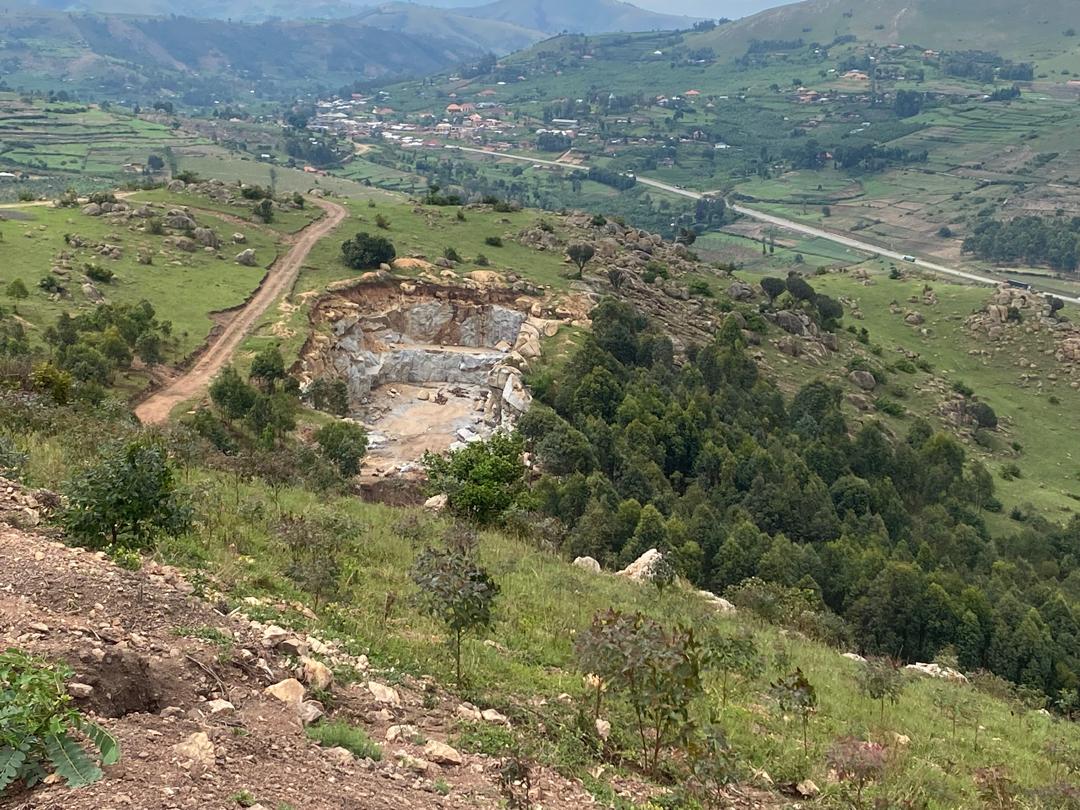
Planted Forests in Uganda: Main Plantations, Their Sizes and Who Runs Them
It depends on what you count. On the published figures we could find, the largest single plantation is Kikonda Central Forest Reserve in Kyankwanzi District: 8,522 ha under plantation in 2020 (FSC, 2020), inside a total project area of 12,182 ha (Gold Standard). The National Forestry Authority (NFA) gives a bigger figure, 11,322 ha “planted to date”, for its Bugamba group of four reserves in Mbarara, Isingiro and Ntungamo. But that is a group, not one forest, and NFA does not say how land replanted after harvest is counted (NFA).
New Forests Company gives the total extent of its Luwunga (8,600 ha) and Namwasa (8,022 ha) estates but not their planted areas (NFC, 2023). Other well-documented examples include Bukaleba, Kachung and Kirinya, and NFA’s Mafuga, Katuugo and Lendu plantations: see the table of ten plantations.
Uganda’s total is disputed too. For 2015, NFA’s mapping gives about 108,000 ha of plantations (UBOS, 2020) and FAO about 416,000 ha (FAO, 2020). The two series are far apart and neither source explains why (details below).
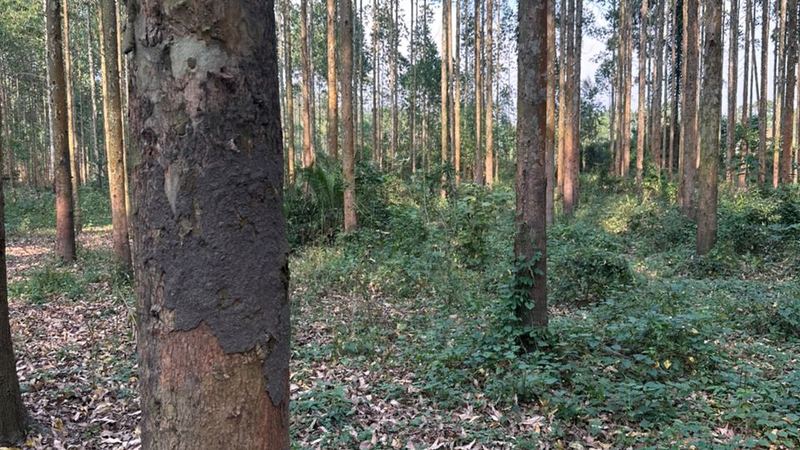
People ask about Uganda's planted forests for three different reasons: they are researching an investment, they are looking for somewhere to sell timber, or they want to know what a well-run plantation actually looks like before starting their own. This guide is written for all three.
One note before the detail. Ownership, licensing and management arrangements in Uganda's forestry sector change — licence holders change, companies restructure, and reserve boundaries are revised. Every figure below is dated and linked to its source in the Sources list, but treat it as the latest published figure rather than a live register, and verify specifics with the National Forestry Authority or the relevant district before acting on them commercially.
Which Is the Largest Planted Forest in Uganda?
There is no official ranking, and published figures measure three different things: the planted area; the gross extent of an estate, licence or project, which can include natural forest and unplanted land (Kikonda’s FSC-certified area of 10,298 ha includes 1,776.8 ha of natural forest (FSC, 2020)); and grouped figures covering several reserves at once. Comparing one kind with another gives the wrong answer, so here is each in turn:
| If you count… | Largest on published figures | Figure |
|---|---|---|
| Planted area of one plantation | Kikonda CFR, Kyankwanzi | 8,522 ha under plantation in 2020 (FSC, 2020) |
| Total extent of one estate | Kikonda CFR, Kyankwanzi | 12,182 ha project area (Gold Standard). Next: Luwunga, 8,600 ha, and Namwasa, 8,022 ha (NFC, 2023) |
| A group of reserves | NFA’s Bugamba group: Rwemitongore, Kyahi, Bugamba and Rwoho | 11,322 ha “planted to date”, undated (NFA) |
Two cautions on the NFA figure. It covers four reserves in Mbarara, Isingiro and Ntungamo, not one forest. And it is more than three times NFA’s next-largest group (Mafuga, 3,432 ha) (NFA), while NFA does not say whether “to date” counts land that has been harvested and replanted. Until NFA explains it, treat its meaning as unconfirmed.
Our answer: if you need one name, Kikonda is the largest single planted forest with a documented planted area. If grouped government figures count, NFA’s Bugamba group is larger. Smallholder woodlots cannot be ranked at all, because no published source measures their total area (see below).
Ten Named Plantations: District, Manager, Area and Species
The table lists ten named plantations with a published area: six run by companies and four of NFA’s own plantation groups. It is not a complete register. Many private plantations publish no figures, and areas change with harvesting, replanting and licence changes. Read the area column carefully: planted means the source gives a planted area; gross extent means the whole estate or licence, including unplanted land.
| Plantation | District(s) | Managed by | Area (ha), year and basis | Main species |
|---|---|---|---|---|
| Kikonda CFR | Kyankwanzi | Nile Fibreboards (see note below) | 8,522 planted, 2020 (FSC); 12,182 gross project area (Gold Standard) | Pinus caribaea, P. oocarpa, P. taeda, Eucalyptus grandis, musizi, teak and others (FSC) |
| Luwunga CFR | Kiboga, Kyankwanzi | New Forests Company | 8,600 gross extent, 2023 (NFC) | Mainly eucalyptus and pine (NFC) |
| Namwasa CFR | Kassanda | New Forests Company | 8,022 gross extent, 2023 (NFC) | Mainly eucalyptus and pine (NFC) |
| Bukaleba CFR | Mayuge | Busoga Forestry Company (Green Resources) | 4,649 in production, 2022; contract area 6,466 (Land Matrix, secondary) | Pinus caribaea and eucalyptus (BFC) |
| Kirinya (private land) | Bugiri | New Forests Company | 3,522 gross extent, 2023 (NFC) | Mainly eucalyptus and pine (NFC) |
| Kachung CFR | Dokolo | Busoga Forestry Company (Green Resources) | 1,972 in operation, from 2022 satellite images; contract area 2,669 (Land Matrix, secondary) | Pinus caribaea and eucalyptus (BFC) |
| Bugamba group: Rwemitongore, Kyahi, Bugamba, Rwoho | Mbarara, Isingiro, Ntungamo | NFA | 11,322 “planted to date”, undated; basis not defined (NFA) | Eucalyptus at Kyahi and Rwemitongore; pine and cypress at Bugamba and Rwoho (NFA) |
| Mafuga group: Kabale, Mafuga, Kirima, Muko, Echuya | Kabale, Kanungu, Kisoro | NFA | 3,432 planted, undated (NFA) | Eucalyptus, pine and cypress (NFA) |
| Katuugo group (also spelt Katugo): Katuugo, Kasagala | Nakasongola | NFA | 2,550 planted, undated (NFA) | Not stated by NFA |
| Lendu group: Lendu, Okavureru, Usi, Awang | Zombo | NFA | 2,296 planted, undated (NFA) | Eucalyptus and pine (NFA) |
NFA also lists South Busoga (Mayuge, 2,499 ha planted) and the Mwenge group (Oruha, Kyehara, Kikumiro and Kagorra in Kyenjojo, 1,711 ha of pine and eucalyptus) (NFA). NFA’s figures come from an undated page of its website, read in October 2026.
Notes. Kikonda’s manager: Global Woods says the project was sold in 2010 and is managed by Nile Fibreboards (Global Woods), and Gold Standard lists Nile Fibreboard Ltd as the developer (Gold Standard), but FSC’s 2020 article still names Global Woods AG (FSC, 2020). The Bukaleba and Kachung areas come from Land Matrix, a land-deal database that cites company sources and satellite images; Busoga Forestry Company’s own public summary gives no hectares (BFC). Do not add gross extents and planted areas together.
Looking to buy pine or eucalyptus rather than research it? We introduce sawmills, traders and investors to plantation owners we work with, and we can measure and value a block before you buy. We hold no stock and list nothing for sale. Tell us what you want to buy.
How Much Planted Forest Does Uganda Have?
Official sources disagree by a factor of almost four for the same year, and none of them explains the gap.
| Source | Year | Planted forest (ha) | What the figure is |
|---|---|---|---|
| NFA records, cited by the African Forest Forum (AFF, 2011) | 2010 | 62,230 | Plantation records: 14,140 ha (23%) government, 48,090 ha (77%) private |
| NFA land-cover mapping, in the national forest accounts (UBOS, 2020) | 2015 | 107,723 | Mapped plantation cover: 63,486 ha coniferous and 44,237 ha broadleaved |
| FAO Global Forest Resources Assessment 2020, Uganda report (FAO, 2020) | 2015 | 415,958 | National estimate based on Uganda’s proposed forest reference emission level of February 2018 |
| Ministry of Water and Environment presentation (MWE, 2023) | 2019 | 314,354 | Land-cover table: 86,236 ha coniferous and 228,118 ha broadleaved |
| FAO Global Forest Resources Assessment 2020, Uganda report (FAO, 2020) | 2020 | 465,156 | The 2000–2015 trend carried forward at 9,840 ha a year; not a new measurement |
| FAO’s 2025 assessment, as reported in the press (Daily Monitor, 2025) | 2025 | 514,000 | Newspaper report; we could not open FAO’s own data, so this is unconfirmed |
Where the figures come from. NFA’s numbers come from its records and from mapping plantation cover; FAO’s are taken from Uganda’s proposed forest reference emission level of February 2018 (FAO, 2020). Neither document explains the gap, and we could not reconcile them, so we show both. The ministry’s 2019 figure sits between the two because broadleaved plantation jumps from 84,137 ha in 2017 to 228,118 ha in 2019 (MWE, 2023). A change in what was counted, such as small woodlots, may explain that jump, but this is our guess and is unconfirmed. The 2025 figure matches FAO’s 2020 figure plus five more years at 9,840 ha a year (514,356 ha, our arithmetic), so it looks like the same trend projected forward rather than a fresh count.
The lower series in more detail. Plantation area more than tripled between 1990 and 2015: the World Bank gives 32,225 ha in 1990 and an estimated 107,608 ha in 2015, with NFA managing around 11% and the private sector the rest (World Bank, 2020). That share is lower than NFA’s own figures imply: the six plantation groups on its undated web page add up to 23,810 ha, about 22% of 107,608 ha (our arithmetic, from NFA). We could not reconcile the two. In 2015, 59,420 ha of mapped plantations lay inside Central Forest Reserves and 45,444 ha on private land (UBOS, 2020).
Four Tiers of Planted Forest
| Tier | What the published figures show | Dominant species | Who runs it |
|---|---|---|---|
| NFA plantations in Central Forest Reserves | Six plantation groups, from 1,711 to 11,322 ha planted (NFA) | Pine, cypress, eucalyptus | National Forestry Authority |
| Licensed commercial plantations | The largest documented, Kikonda, had 8,522 ha planted in 2020 (FSC); NFA reports promoting 37,000 ha of private planting in reserves (NFA) | Pine, eucalyptus | Companies holding NFA licences over reserve land |
| Private plantations on titled land | 45,444 ha of mapped plantations on all private land in 2015 (UBOS, 2020) | Eucalyptus, pine | Individuals, families, investment companies |
| Smallholder woodlots | No published total (see below) | Mainly eucalyptus | Individual farmers and landowners |
The distinction that matters commercially is the second row versus the third. A licence over reserve land is permission to plant, with conditions and an end date; it does not make you the owner of the land. NFA says land allocated for tree planting cannot be transferred: a licence holder can give up the licence and pass on the trees only if the new party accepts the same conditions (NFA FAQs). Titled land is an asset you own. Investors regularly conflate the two, and the difference shows up sharply when it is time to sell.
Plantations Inside Central Forest Reserves
Uganda has a large network of Central Forest Reserves, managed by the National Forestry Authority under the National Forestry and Tree Planting Act 2003 (Act, Cap. 160). Not all of them are planted — many are natural forest, and some are heavily degraded — but more than half of the country’s mapped plantation area sits inside them: 59,420 of 107,723 ha in 2015 (UBOS, 2020).
NFA runs its own plantations in groups: Bugamba in Mbarara, Isingiro and Ntungamo; Mafuga, which includes Muko, in the south-west highlands; Katuugo (Katugo) in Nakasongola, in the central cattle corridor; Lendu in Zombo, in the north-west; Mwenge in Kyenjojo; and South Busoga in Mayuge (NFA). Companies run large plantations under licence in other reserves, including Kikonda in Kyankwanzi, Luwunga and Namwasa in the central belt, and Bukaleba and Kachung in Mayuge and Dokolo (table above). The highland Mafuga group grows pine, cypress and eucalyptus (NFA); the cooler, higher ground suits Pinus patula.
Two practical points for anyone buying timber:
- Reserve timber comes with paperwork. Harvesting and movement from a Central Forest Reserve is more tightly controlled than harvesting from private land. That is a feature, not a nuisance — documented chain of custody is worth money to serious buyers.
- Encroachment is a real risk factor. Some reserves have long-running settlement and encroachment issues. If a deal depends on reserve land, that is a due-diligence question, not a footnote.
The SPGS Era and What It Built
The single most important thing to understand about Uganda's modern plantation estate is that most of it is young, and most of it exists because of a grant scheme.
The Sawlog Production Grant Scheme (SPGS), launched in 2004 with European Union funding and later Norwegian support, paid private growers a per-hectare grant against verified planting and survival standards: UGX 850,000 per hectare for growers of 25–500 ha and UGX 600,000 for 501–3,000 ha, paid over three years (MWE, 2023). Crucially, it paid on results — money was released only after SPGS staff had checked the site against agreed standards, so it followed surviving, well-tended trees rather than seedlings put in the ground.
The ministry credits the scheme’s three phases (2004–2021) with about 81,000 ha of plantations (MWE, 2023). The World Bank reported in 2020 that about 70% of private plantations had benefited from grants and other incentives, mainly through SPGS, and that of about US$41 million in funding, US$34 million came from the EU, US$5 million from Norway and US$2 million from the Government of Uganda (World Bank, 2020).
Three consequences that still shape the sector:
- A generation of plantations reaching maturity together. Blocks established from the mid-2000s onward are now at or approaching harvest — FAO notes that over 80,000 ha of commercial plantations, mostly pine, have been established since 2005, and that pine needs 18 years to reach full maturity (FAO, 2020) — which is why sawmilling capacity and timber marketing have become live commercial questions.
- A raised technical standard. SPGS inspections normalised things that had been optional — proper spacing, timely weeding, firebreaks, records. Growers who came up through the scheme run visibly better plantations.
- A pipeline of large private growers. Much of the commercial estate on titled land traces back to that period.
"You can usually tell an SPGS-era block from the road. Straight lines, maintained firebreaks, weeded in the first year. The difference between that and an unmanaged woodlot at year seven is not 20% of yield — it is often the difference between saleable poles and firewood."
— Euca Eco Consults Field Team
Planning a block? We assess sites the way the grant inspectors did.
Where the Plantations Are
| Region | Districts | Named plantations (tables above) | Character |
|---|---|---|---|
| Central plantation belt | Mubende, Kassanda, Kiboga, Kyankwanzi, Nakaseke, Nakasongola, Luwero, Mityana | Kikonda, Luwunga, Namwasa, Katuugo | The heart of private commercial forestry. Land available in blocks, decent soils, reachable from Kampala. |
| Bunyoro | Masindi, Hoima, Kikuube, Kibaale | None with a published area in our tables | Good soils, established timber processing, proximity to Budongo. |
| Tooro | Kyenjojo | Mwenge group (NFA) | NFA pine and eucalyptus. |
| Ankole | Mbarara, Isingiro, Ntungamo | Bugamba group (NFA) | NFA eucalyptus for poles and timber, and pine and cypress. |
| South-west highlands | Kabale, Rukiga, Kisoro, Rubanda, Kanungu | Mafuga group, including Muko (NFA) | Pine country. Cool, high, steep. P. patula and E. globulus. |
| Lake Victoria crescent | Wakiso, Mukono, Mpigi, Masaka | None with a published area in our tables | Smallholder eucalyptus at scale. Small plots, high land prices, short haul to market. |
| North and West Nile | Gulu, Lira, Dokolo, Nebbi, Zombo, Arua | Kachung, Lendu group | Unimodal rainfall. E. camaldulensis, teak in the west, higher fire risk. |
| Eastern | Mbale, Kapchorwa, Iganga, Bugiri, Mayuge | Bukaleba, South Busoga, Kirinya | Mixed. Highland pine and eucalyptus in the Elgon districts; commercial blocks in Busoga. |
What Is Actually Planted
Pine and eucalyptus dominate. By the end of 2010, Pinus caribaea made up 75% of government plantations and 54% of private plantations, with eucalyptus at 17% of private plantations (AFF, 2011). Mapped plantation cover in 2015 was 63,486 ha coniferous and 44,237 ha broadleaved (UBOS, 2020).
- Pinus caribaea — the backbone of the large commercial estate, grown for sawn timber, and tolerant of poorer, more acidic soils. FAO notes that pine plantations need 18 years to reach full maturity (FAO, 2020). See our pine plantation guide.
- Pinus patula and P. oocarpa — 8% and 6.5% of government plantations in 2010 (AFF, 2011). P. patula is the highland pine, in Kabale, Kisoro and the Elgon districts.
- Cypress (Cupressus lusitanica) — small areas in government plantations (AFF, 2011), including NFA’s south-western groups (NFA).
- Eucalyptus grandis and GU/GC clones — the pole crop. The GC and GU hybrid clones were imported from South Africa in 2002–2003 (AFF, 2011). Eucalyptus coppices, which is one reason smallholders choose it; for harvest ages see our eucalyptus rotation age guide.
- Eucalyptus camaldulensis — the drier north and marginal sites; firewood and charcoal.
- Teak (Tectona grandis) — small areas in government plantations (AFF, 2011) and listed at Kikonda (FSC, 2020); a pronounced dry season suits it.
- Indigenous species — musizi, muvule, mahoganies. Small in area, long in rotation, high in value. See our musizi guide.
The Smallholder Estate Nobody Counts
Smallholder woodlots — mostly eucalyptus, mostly serving the pole market — are spread across the country but are largely invisible in official statistics. We could not find any published figure for their total area, so we cannot say whether, taken together, they outrank the big estates. An earlier version of this page said they did; we have withdrawn that claim. The nearest number is 45,444 ha of mapped plantations on private land in 2015, which also includes company estates (UBOS, 2020). The third phase of SPGS aimed to include 4,000 ha planted by smallholder community groups (World Bank, 2020).
Woodlots exist because the economics are unusually good for a smallholder: land that produces nothing becomes an asset within a few years, the crop does not need harvesting on a schedule, it is not stolen easily, and it coppices for a second and third rotation. It is one of the few rural investments in Uganda that behaves like a savings account with a yield.
The weakness is management. A large share of smallholder woodlots are planted too tight, never weeded in the critical first year, never thinned, and sold unmeasured to the first buyer who appears. Each of those is fixable and each of them costs money — see how to find and vet tree buyers.
What the Big Growers Got Right
You do not need a thousand hectares to copy the practices that make commercial plantations work:
- They match species to site before buying seedlings, rather than planting what the neighbour planted.
- They weed properly in year one. Nothing else in the rotation returns as much per shilling spent.
- They maintain firebreaks every dry season. A block that burns at year eight is a total loss.
- They keep records — planting date, species, spacing, survival counts, operations. Records are what turn a woodlot into a valuable asset at sale.
- They measure before they sell. Unmeasured timber is always priced against the grower.
- They plan access roads at planting, not at harvest.
If you are considering your own block, start with the site: our forestry consultancy service covers feasibility and species matching, and forest investment returns in Uganda sets out the economics.
Frequently Asked Questions
What is the largest planted forest in Uganda?
It depends on what you count. On the published figures we could find, the largest single plantation is Kikonda Central Forest Reserve in Kyankwanzi District, with 8,522 ha under plantation in 2020 (FSC, 2020). The National Forestry Authority reports 11,322 ha “planted to date” for its Bugamba group of four reserves in Mbarara, Isingiro and Ntungamo, but that is a group, not one forest, and NFA does not define the figure (NFA).
New Forests Company gives the total extent of its Luwunga (8,600 ha) and Namwasa (8,022 ha) estates but not their planted areas, so they cannot be ranked against Kikonda (NFC, 2023). Smallholder woodlots are widespread, but no published source measures their total area. Verify specifics with NFA before relying on them commercially.
What are examples of planted forests in Uganda?
Well-documented examples run by companies are Kikonda (Kyankwanzi), Luwunga (Kiboga and Kyankwanzi), Namwasa (Kassanda), Bukaleba (Mayuge), Kachung (Dokolo) and Kirinya (Bugiri). The National Forestry Authority runs its own plantation groups: Bugamba (Mbarara, Isingiro, Ntungamo), Mafuga, which includes Muko (Kabale, Kanungu, Kisoro), Katuugo (Nakasongola), Lendu (Zombo), South Busoga (Mayuge) and Mwenge (Kyenjojo) (NFA).
Below these sit many private plantations on titled land and smallholder woodlots, mostly eucalyptus, for which no complete register or total area is published.
What is the difference between a natural forest and a planted forest in Uganda?
A natural forest — Budongo, Mabira, Kibale — regenerates itself and contains mixed indigenous species of varying ages. A planted forest is established deliberately, usually as a single species at uniform spacing and age, for a defined product.
The two are governed differently. Harvesting from natural forest and from gazetted reserves is far more tightly controlled than harvesting a private plantation on titled land.
Can I buy or lease land inside a Central Forest Reserve to plant trees?
Reserve land is not sold. Commercial planting inside Central Forest Reserves happens under licence from the National Forestry Authority, with conditions and a fixed term.
That distinction matters at exit: a licence is permission to plant with an end date, not an owned asset, and investors regularly conflate the two. NFA says land allocated for tree planting cannot be transferred; a holder can give up the licence and pass on the trees only if the new party accepts the same conditions (NFA FAQs). Get the tenure position confirmed in writing before committing capital.
What was the Sawlog Production Grant Scheme?
SPGS was a donor-supported grant scheme launched in the mid-2000s that paid private growers per hectare against verified planting and survival standards. It paid on results rather than intentions — inspectors checked spacing, weeding, survival and firebreaks before money was released.
It is the main reason Uganda has a generation of commercial plantations maturing at roughly the same time, and the reason technical standards among established growers are noticeably higher than among newer entrants.
How much of Uganda's timber comes from plantations rather than natural forest?
The share has shifted substantially toward plantations as the SPGS-era blocks have matured, and that shift is the intended outcome of the policy — taking harvesting pressure off natural forest by supplying the market from planted sources.
Published figures vary by source and by year, so treat any single number with caution. The direction of travel is not in doubt.
Sources
Figures on this page were checked against these documents in October 2026. Land Matrix and the Daily Monitor are secondary sources and are marked as such where used.
- FSC Africa (15 July 2020). Biodiversity and livelihoods flourish in Uganda’s FSC certified plantations. Kikonda: 10,298 ha certified, 8,522 ha under plantation, 1,776.8 ha natural forest; species.
- Gold Standard registry. Project 1798, Kikonda Forest Reserve. Total project area 12,182 ha; developer Nile Fibreboard Ltd.
- Global Woods. Kikonda Forest Reserve project page (copy hosted by Land Matrix). Project started in 2002, sold in 2010, now managed by Nile Fibreboards.
- National Forestry Authority. About NFA: Plantations Directorate (undated; read October 2026). Planted areas of NFA’s six plantation groups; 37,000 ha of private planting promoted in reserves.
- National Forestry Authority. Frequently asked questions. Transfer of land allocated for tree planting.
- New Forests Company (2023). Plantation Management Plan: Public Summary for Ugandan Plantations (copy hosted by Land Matrix). Namwasa 8,022 ha, Luwunga 8,600 ha and Kirinya 3,522 ha in extent; mainly eucalyptus and pine.
- Busoga Forestry Company (Green Resources). Management Plan Summary 2020–2025. Fifty-year permit for Bukaleba and Kachung reserves; growth models for Pinus caribaea and Eucalyptus saligna; no hectares given.
- Land Matrix (secondary). Deal 3020: Bukaleba Forest Project (record of September 2025). Contract area 6,466 ha and 4,649 ha in production (2022), from company sources.
- Land Matrix (secondary). Deal 3156: Kachung (record of December 2024). Contract area 2,669 ha; 1,972 ha in operation, from 2022 satellite imagery.
- FAO (2020). Global Forest Resources Assessment 2020: Uganda country report. Plantation forest 415,958 ha (2015) and 465,156 ha (2020, extrapolated at 9,840 ha a year).
- Daily Monitor (secondary, 8 November 2025). Report on FAO’s 2025 forest assessment for Uganda. Planted forest 514,000 ha (2025).
- Uganda Bureau of Statistics, National Planning Authority and WAVES (June 2020). Uganda Wood Asset and Forest Resources Accounts Report 2020, with tables adapted from NFA (2019). Plantation cover 1990–2015; plantations inside reserves and on private land.
- World Bank (April 2020). Project Appraisal Document: Uganda Investing in Forests and Protected Areas for Climate-Smart Development (P170466), hosted by NFA. Plantation area in 1990 and 2015; NFA’s share; SPGS reach and funding.
- Kazungu, B., Ministry of Water and Environment (24 January 2023). Presentation to the Yale Forest Forum. Land-cover table to 2019; SPGS phases, grants and area planted.
- Kaboggoza, J. (2011). Forest Plantations and Woodlots in Uganda. African Forest Forum Working Paper Series, Vol. 1, Issue 17. Plantation area and species shares at the end of 2010, citing NFA.
- FAO (2020). Reducing export restrictions on timber to sustain commercial forestry investments in Uganda. Policy brief. Pine plantations need 18 years to reach full maturity.
- Government of Uganda. National Forestry and Tree Planting Act 2003 (Cap. 160), text on UNEP’s LEAP database.
Thinking About Joining Them?
Uganda's plantation estate was built by people who started with one block. We assess the site, model the returns and tell you honestly whether it works.
Over a decade establishing, measuring and managing eucalyptus, pine and indigenous plantations across Uganda. Based in Wakiso, Kampala. First published August 13, 2026; updated October 10, 2026 with sourced, dated figures.